
In most AI projects I see, the model is not the first thing that breaks. The process is.
A model can predict that a delivery will delay invoicing. It can flag a supplier risk, identify a missing document, or recommend the next action in sales. That output only matters if someone can act on it.
If nobody owns the exception, the status is unclear, or action starts only after the damage is done, the model has not created value. It has just added another item for people to interpret. This is one reason AI pilots often look promising but fail to change the numbers. The model may be fine. The handover, ownership, or follow-up around it often is not.
Survey data points in the same direction. McKinsey's 2025 State of AI report found that high performers are more likely to redesign work around AI, not just add tools on top of existing workflows.
Give AI a Specific Job
As a data scientist, I care about models. Features, algorithms, pipelines, training data, and evaluation metrics all matter. But in many business environments, what looks like model error is often process noise wearing a technical label. The model may be learning from signals that are late, ambiguous, incomplete, or disconnected from the decision people actually need to make.
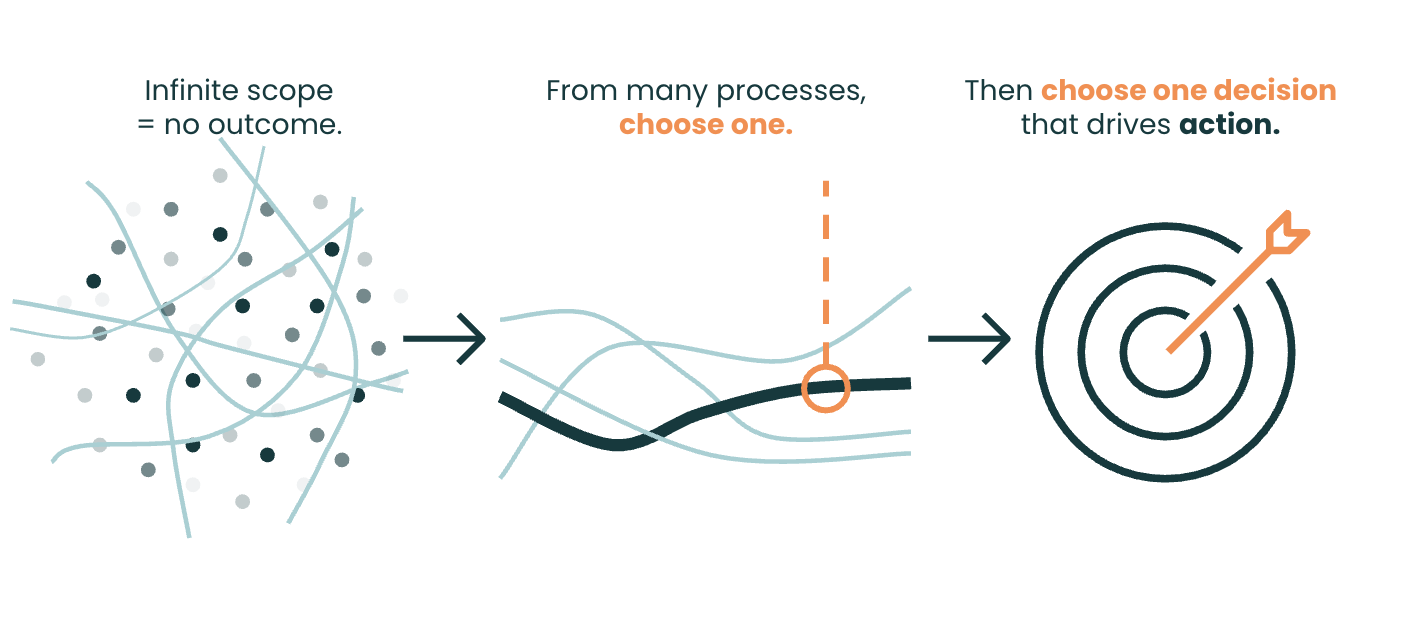
That is why the starting point should be smaller than most AI programmes assume. Many organisations begin by asking, “How do we make our data AI-ready?” or “Which AI use cases should we build?” Those are reasonable questions, but they easily create an infinite scope. Every data set seems relevant, every process has exceptions, and every function has possible use cases.
I would start smaller:
Which business process matters enough to improve?
Which decision inside that process needs better support?
Which signal would help people act before the delay turns into cost?
The process could be order-to-cash, demand planning, procurement, claims handling, customer onboarding, field service, or regulatory monitoring, but the decision should be concrete. Not "improve cash flow," but "which deliveries are ready to invoice, which are blocked, and who needs to act?"
The signal is what AI can help sharpen: a likely delay, a missing confirmation, an exception that should not wait, or a next action that is easy to miss. Once the process, decision, and signal are clear, AI has a specific job.
The question is no longer “Where could we use AI?” It becomes “What would help this decision happen earlier, with less uncertainty, or at greater scale?” That is also where the quality of the signal starts to matter.
AI Amplifies Unclear Process Signals
Data is AI-ready only when the business knows what decision it should support. A record can be complete in the system and still be useless for the decision.
Take a simple example like a delivery status. In many organisations, a shipment may be marked as "delivered". But what does delivered mean? Did it leave the warehouse, arrive at the customer site, get received by the customer, get accepted without exceptions, or become ready for invoicing?
“For a human expert, the ambiguity may be manageable. They know who to ask, which system to check, and how to interpret the exception. An AI model does not have that informal context unless the organisation has made it visible.”
If the process keeps creating incomplete, delayed, or ambiguous signals, downstream data cleaning only treats the symptom. The same issue returns because the source of ambiguity has not changed. From a model's point of view, this may look like a data quality problem. From a business point of view, it is a process problem.
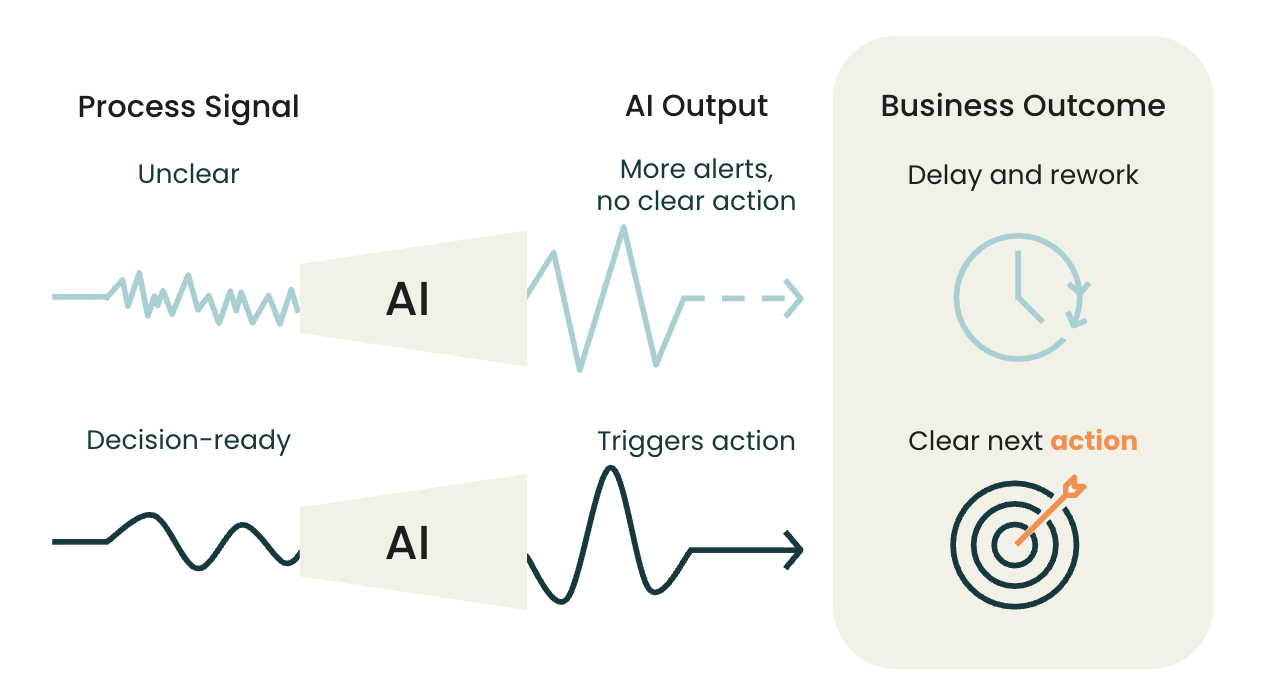
AI does not remove the ambiguity. It may distribute it faster, often with a confidence score attached. It may produce more predictions, more alerts, and more confident-looking outputs, while the organisation still struggles to act.
Example: Delivery to Invoicing
In delivery-to-invoicing, “delivered” is not enough. The useful signal is more specific. Whether the delivery is ready for invoicing, blocked by an exception or likely to create a cash delay unless someone acts now.
That signal needs a few pieces of context: customer receipt, exception reason, timestamp, owner, and invoice readiness. AI could help identify which shipments are likely to delay invoicing, which exceptions need human review, or which customer confirmations are missing. But the value does not come from the prediction alone.
The value starts when the prediction makes someone act: Contact the customer, correct the status, resolve the exception, release the invoice, or escalate the issue before the cash impact grows.
The prediction only matters when it changes what happens next.
Make the Signal Reliable
A process becomes AI-ready when it makes the right signal hard to miss and hard to misinterpret. That does not require a large data programme. It requires operating discipline around four things:
Ownership: Define who owns the process, not only the dataset. That owner should know what the key business events mean, where the signal is created, which exceptions matter, who should act, and how the outcome is measured.
Metadata: A delivery status is more useful when it is tied to a stable business object, a reliable timestamp, the process step, the responsible team, the exception reason, and the decision it supports.
Guardrails: Required context at the point of work, shared definitions for key statuses, stable object IDs across systems, and clear exception ownership make the signal repeatable.
Feedback: If an AI output is wrong, ignored, too late, or not useful, the process should capture that. Otherwise the organisation has no way to improve the decision loop.
At that point, data quality stops being a cleanup task. Instead of cleaning the same ambiguity downstream, improve the process so it produces a decision-ready signal in the first place.
Choose One Decision Loop at a Time
Choose one important process. Name one decision. Define one signal. Then strengthen the ownership, metadata, guardrails, and feedback around how that signal is created and used.
This is narrow enough to manage, but important enough to matter. Once one decision loop works, the organisation can apply the same logic to the next process, the next decision, and the next signal.
That is how AI maturity builds: not through a generic data readiness programme, but through repeated improvements to the way processes create decision-ready signals..
“The process creates the signal. AI can scale it. Value appears only when people do something differently because of it.”

About the Author
Eero Siivola is a Data Scientist holding a Ph.D in machine learning and over 10 years of experience applying advanced analytics across diverse domains. He specialises in designing data workflows, developing analytical models, and leading projects from concept to delivery. Eero has a proven ability to translate customer needs into practical solutions that drive measurable business impact.