
"Where is the Money?" – Answering Critical Business Questions with Modern Data Leadership
We are drowning in data and reports but starving for insights. It is time to shift focus from merely decoupling data to actually utilising it to solve critical business problems.
Picture the scene. It is autumn, and a Business Unit Director sends a message to the CIO: "Do you know where our money is? The figures have dropped, and we need to know why. What should we do? Is there anything in the data that can help us?"
When it comes to data, you are likely to fall into one of two camps upon hearing that request:
The "Excel Hell" approach: You open the ERP, run several reports, speak to four different managers, and create three different spreadsheets. Three weeks later, you have some graphs in Excel. They answer the question, but they are hopelessly late. The situation has already moved on.
The "IT Hope" approach: You rely on a scalable architecture in which data is decoupled from source systems and stored in a data lake. You hope that eventually, someone will build a view of that data that generates value. But it is rare to deliver business-led capabilities within three weeks through a data catalogue.
This is the vicious cycle of data utilisation. Business leaders do not trust the data, so they build shadow processes, which leads to data not being updated in the systems, creating poor data quality, which further erodes trust.
It is time to break this cycle. Modern data leadership is much more than setting up a data platform project; it is about productising information to answer critical business questions now.
Moving Beyond the Executive Dashboard
In many organisations, the gap between business and IT is hindering overall performance. In practice, the gap shows in IT departments that speak about data platforms and AI pilots, while business units simply try to get work done, hoping for a day when they might have time to actually analyse and improve performance systematically.
Modern data-driven management requires a fundamental shift: Business owns the information needs; IT meets them halfway with productised data.
Traditionally, data management focused on the top of the pyramid: executive reporting for the management team. While financial metrics are vital, modern success lies at the bottom of the pyramid, a.k.a. operational execution.
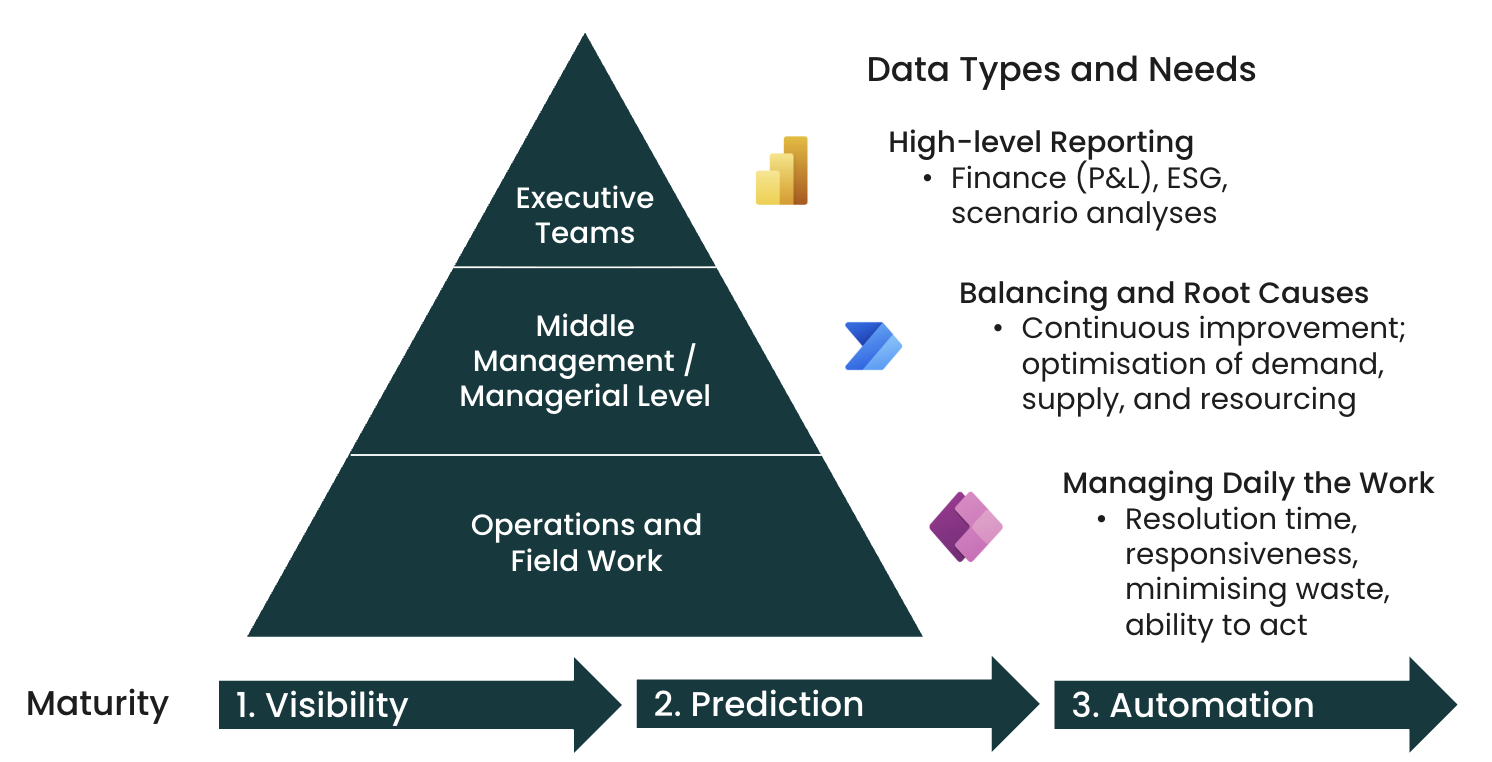
We must bring up-to-date knowledge and decision-making power as close to operations as possible, to the people who know the processes best. A simple Power BI report is rarely enough for this. Employees on the operative level need actionable alerts, applications to act on insights, and AI tools that guide their daily work. This brings Lean thinking back into fashion: using data to drive operational efficiency with immediate feedback loops.
The Future is Not a Dashboard, Meet the Knowledge Graph
If you are following the tech landscape, you may have seen Klarna’s moves from spring 2025. Beyond the headlines of letting go and rehiring customer service agents, and replacing Salesforce and Workday, the real story is their investment in an "AI tier" data modelling and access layer, essentially known as Knowledge Graphs.
Standard dashboards struggle to answer complex questions, such as "Who does Employee X usually work with?" because data is trapped in tables and columns. To address this, Knowledge Graphs, Ontologies, and Process Graphs are emerging as a more natural way to model data, connecting structured and unstructured data from CRM, ERP, and finance systems into a unified data network.
As we move deeper into the world of Agentic AI, clean ERP tables aren't enough. AI needs context, and results need to be traceable back to deterministic queries. Agents need to know how a project links to an invoice, which links to a supplier, what similar materials other suppliers provide, and how a specific KPI is derived from source data. Investing in this semantic layer enables you to build capabilities on functional-domain data and, more importantly, understand the full value chains within your data.
The bottleneck is not the availability of data, but the productisation of the context and meaning associated with interpreting and utilising it.
The Strategic Pivot of the Data Foundations
The challenge to every Data Director and CEO is this: reflect on your investment portfolio. Most organisations invest heavily in the bottom layer: data platforms, storage, and governance. They hope the value will trickle up.

But what if you shifted focus?
Start with the critical business question. Identify the burning platform, the questions leadership teams lose sleep over. Build a vertical slice, from data source to decision, that solves that specific problem. With the right data architecture, you can always expand. The end result is the same: you have decoupled data from source systems, and you can also answer important questions such as "Where is the money?"
By focusing on addressing specific business information needs, we can bridge the gap between IT’s capabilities and the business’s urgent need for clarity.
For more on the topic, listen to a recent keynote by Antton Ikola at the CxO Data 2025 event (in Finnish).

About the Author
Antton Ikola is an expert in data-driven management who has worked across multiple industries, solving complex business challenges for clients. He possesses a strong understanding of technology and strategy, but above all, has the ability to create concrete, data-backed solutions to business problems.