
Dashboard-Rich, Decision-Poor? The Data-Driven Leadership Challenge AI Will Only Amplify
Most organisations chasing AI results are solving the wrong problem. The real bottleneck isn't the technology, but the vicious cycle between bad data and broken processes that no platform or model can fix on its own. All the while, the AI intelligence boom is reshaping your competitive position and deciding where the real moat is being built.
The Data Gap and Vicious Cycle
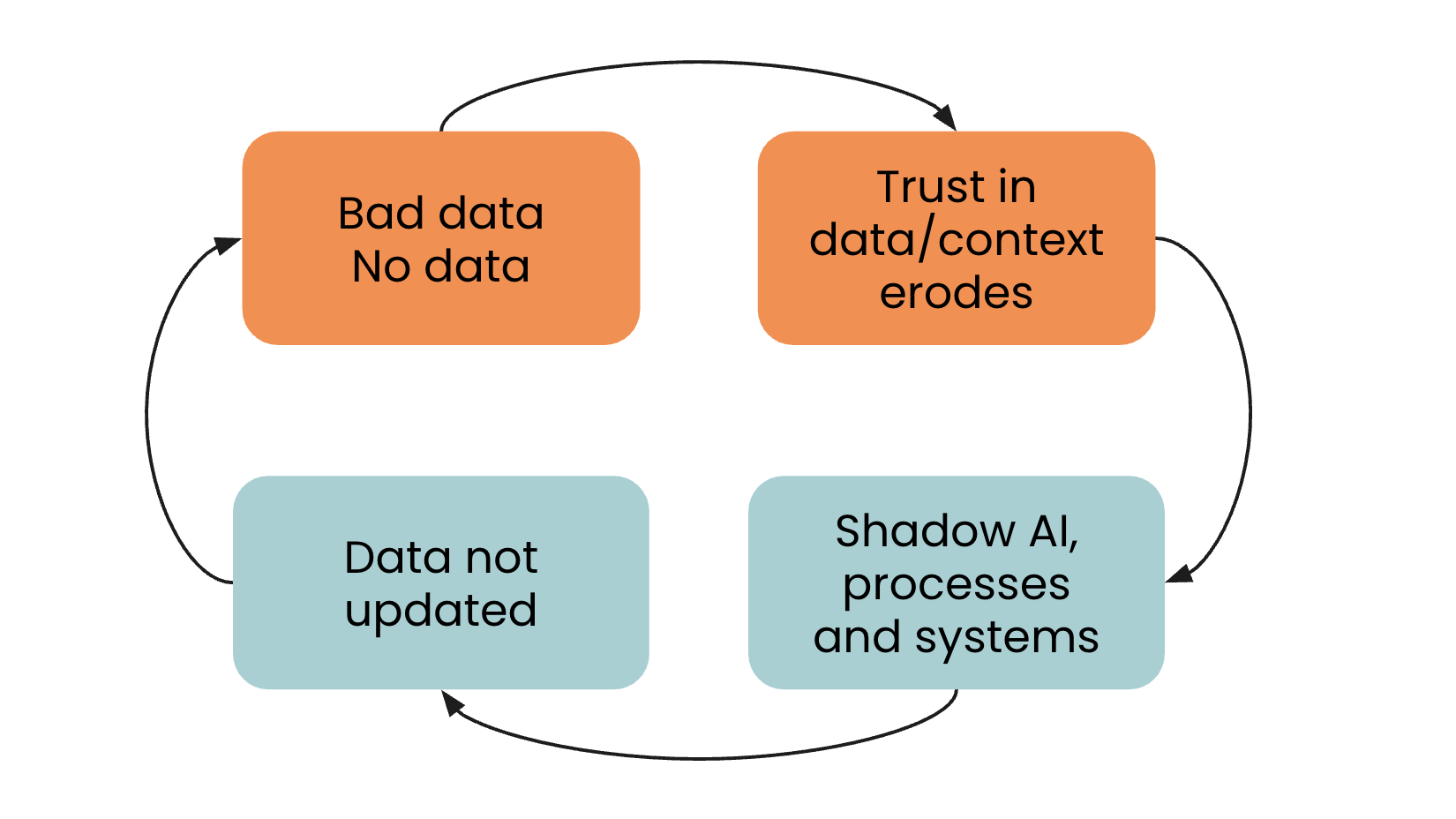
When organisations start their data and AI journey, they usually blame the data. "Our data is bad" becomes the accepted truth, and eventually, an excuse. Some companies push through and build anyway. Others wait for the new ERP system that will also modernise the processes. Tech and data-driven paths tend to lead to a lot of investment, slow and cumbersome change.
You can't fix the data without fixing the processes that produce it. And you can't fix the processes without good data to understand them. It's a chicken-and-egg problem that has paralysed organisations for decades.
The result is shadow processes. Someone patches the gaps with their own Excel. Another builds a workaround in ChatGPT or writes a quick script to compensate. These shadow systems proliferate silently, each one a sign that the official systems and data aren't trusted.
Dashboard-Rich, Decision-Poor
The irony is that many organisations are not short on data or reports. They're short on decisions, on levels where impact is actually realised.
“We've walked into organisations with 5000 Power BI reports, and teams that still don't know where to look when something goes wrong.”
We've walked into organisations with 5000 Power BI reports, and teams that still don't know where to look when something goes wrong. The problem is that most data work started from the wrong question: "What data do we have?" instead of "What decisions do we need to support, and for whom?"
When you flip that question, everything changes. Leadership teams don't need tens of reports. They need a small number of clear signals. Where is the money, the opportunity, the risk? Middle management needs to diagnose root causes. And operations need to act with confidence, day to day.
Data work built around decisions tends to earn trust quickly. Data work that starts from the data lake rarely ends up in business use.
And yet most data still flows upward to management while operations remain underserved. Lean manufacturing figured this out decades ago by pushing decision-making capability to where the richest information lives. The factory floor, the service rep, the project manager. The tacit knowledge embedded in daily operations is the context that makes the data interpretable.
What the AI Era Actually Changes
Something important has happened in the last two years: interfaces, models, and AI orchestration have become a commodity. Anyone can spin up a functional CRM over a weekend. Models get replicated in weeks. The marginal cost of applying intelligence is approaching zero.
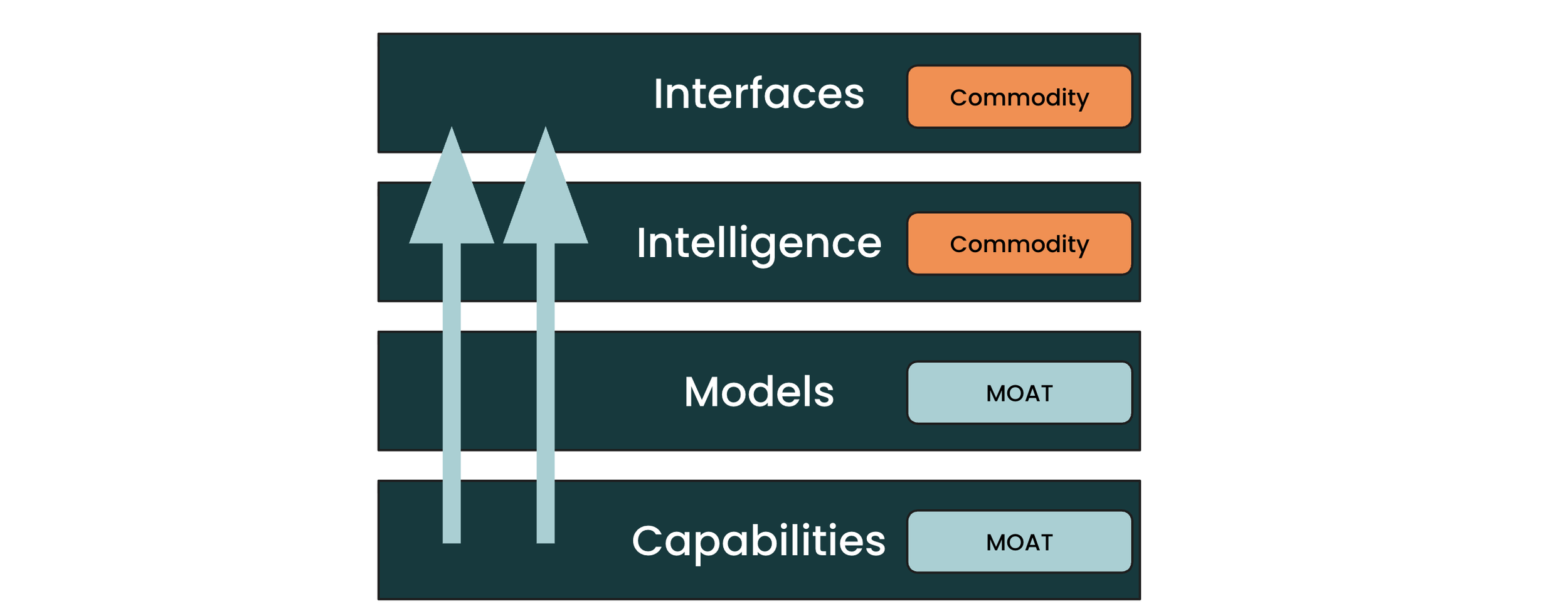
The layers that remain hard to copy require deep organisational understanding: how your customers behave, how your end-to-end processes work, and what your people know but haven't yet made explicit. Things built through years of trial and error can't be downloaded or reverse-engineered. Because the top layers are now cheap to build, organisations that have modelled these things well are about to see the returns multiply.
The question worth asking isn't the FOMO-driven "how do we get better at utilising AI?". It's "how do we make our organisational knowledge accessible to both people and AI systems?"
The Missing Layers Between Your Business, Data and AI
Each time data is modeled, some underlying assumptions of basic business terminology need to be investigated, many times reinvented. This connective tissue between what truly matters and what we know about it is called many different things; a semantic layer, a context graph, and so forth.
Instead of every report, dashboard, and AI agent interpreting your raw data independently, you define your business logic once in a shared layer that everything else builds on. What counts as an active customer, or a churned one? How do you measure profitability in a service business? Which customer records across three systems actually refer to the same organisation?
Define it once, use it everywhere.
This matters more now than it ever did, because AI agents and language models need to query your data in business terms not database terms. The gap between how your data is stored and how your people think about the business has always existed. Historically it was bridged by analysts who knew both worlds. As AI systems increasingly need to bridge that gap autonomously, the bridge needs to be explicit, validated, and shared.
The Real Work Ahead
Three shifts matter most.
Operations teams must become the primary beneficiaries of data work, not just the source of it. When the people producing data also benefit from it, the incentive to keep it accurate changes fundamentally.
Data teams must shift focus from pipelines to decisions. What decisions does this data need to support? Who makes them? These questions should come before any technical choices.
The path from insight to action is where most organisations are still stuck. Dashboards are a starting point, not a destination. Real P&L impact comes when data enables people and AI to decide and act, or simply gives the right person the right nudge at the right time.
Intelligence is now on tap, meaning the bottleneck has moved. The question is no longer whether you can afford good AI but whether your processes and data are ready to unlock the value.

About the Author
Antton Ikola is an expert in data-driven management who has worked across multiple industries, solving complex business challenges for clients. He possesses a strong understanding of technology and strategy, but above all, has the ability to create concrete, data-backed solutions to business problems.