
End-to-End Process Management and AI: From Development to Real Results
Business processes are constantly being developed, but how often does that work truly translate into tangible and measurable results? Process Director Milja Leppänen from Elisa and VP, Process Analytics & Data Joona Soratie from Vuono Group shared the stage in Prosessipäivät 2026 to dive into succeeding in end-to-end process management in the age of AI.
They covered three themes that any process-driven organisation and process professional will recognise:
How processes connect departments, goals, and people into a coherent whole
How AI and data can be woven into everyday development
How continuous learning becomes a structural part of how organisations improve.
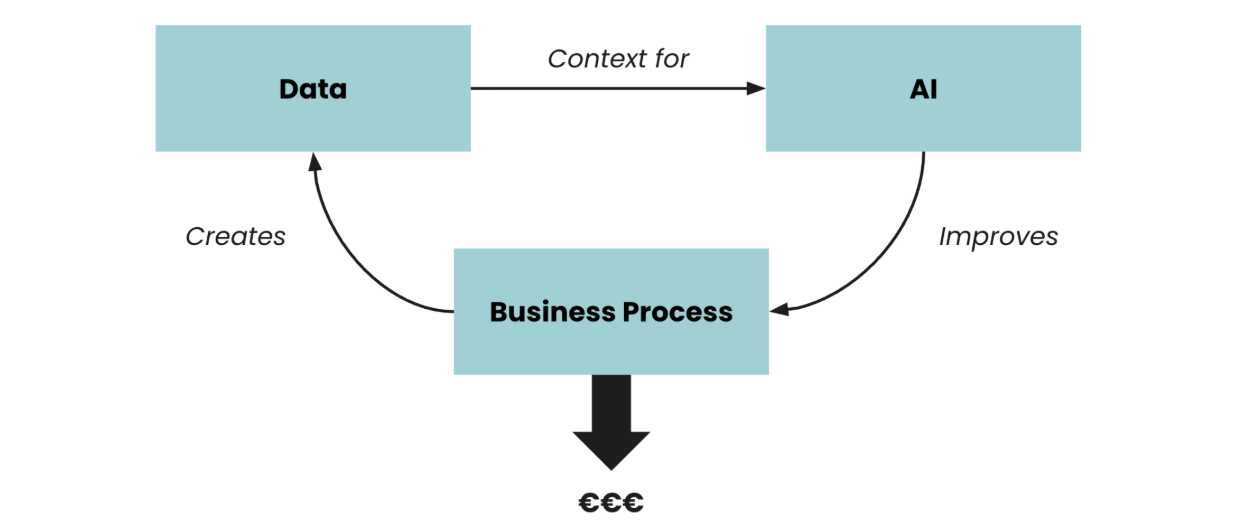
Business Processes Turn Data and AI into Value
Every company runs their business on processes. Data alone is worth zero. But what does it actually mean to combine AI and process development?
“When we talk about AI and process development, one thing needs to be said out loud immediately: this is not about adding AI to existing processes and continuing as before.”
“Processes are the foundation. The structured but agile, customer-value-defined, and optimized business algorithms that allow AI to create concrete business value.”
Harvard and MIT research back these expert views up. The Harvard article emphasizes how process thinking and AI should be combined to critically redesign business processes. The MIT research highlights the maturity path of AI. Real business value emerges when AI is deeply integrated into processes rather than used in isolation.
Successful Process Management Starts with the Customer Value
“When the customer guides the process, everyone wins. The customer, the business, and the people doing the work.”
When Milja Leppänen stops to think about process work, she starts with two questions: Where are we now? Where are we going?
AI era invites to approach process development from E2E perspective. This means asking what the customer's everyday life feels like today, and how to build the foundation for a smoother, more anticipatory and predictive experience tomorrow.
Customers do not think about processes. They think about whether what they need actually works. That, she argues, is exactly where process work must start.
Process Excellence in the Age of AI
A process creates the framework for what needs to get done. Without a clearly defined and managed process, work fragments, responsibilities blur, and the customer experiences friction. Data tells us how the process actually work. It surfaces problems that would otherwise be hard to talk about and directs development to where it has real impact.
But in the age of AI, this is not enough on its own.
When the current state is genuinely clear, it becomes possible to ask more fundamental questions: Why is this process built this way at all? Does it even need to exist in this form? That is when the door opens to AI-led, AI-native, and increasingly agentic processes, that do not merely react, but anticipate intuitively
“Understanding today’s processes is essential, but it’s not enough. Without a strong future vision and target state, AI will only make processes faster, not better, and not transformative.”
Putting It Into Practice: Results That Speak for Themselves
Leppänen illustrated her thinking also with a concrete process development example. The process was mapped first from an internal perspective, then through the customer's eyes. The data told the story: where does the customer have to wait, how many contacts do they make, how long does the full journey take?
When the pain points became visible, cross-functional experiments followed with marketing, sales, delivery, and business all involved. The results were significant:
On-time deliveries increased clearly
Lead times shortened by tens of percent
Errors decreased significantly
Customer satisfaction rose
Follow-up calls and resolution work almost disappeared.
The Process of Tomorrow Starts Today
Leppänen and Soratie approach the topic from different angles, but their argument is the same: Better AI alone does not create business value. Value emerges when AI boosts processes that are customer-driven and grounded in operational reality.
That foundation is what makes AI meaningful. Without it, AI simply makes yesterday's processes faster. With it, organisations can ask the question that matters: if we were designing this process today, knowing what AI can do, what would we build?
Processes that do not react, but anticipate. Processes that the customer never sees, but always feels.

Milja Leppänen, Process Director, Elisa
Milja Leppänen has over ten years of experience in process development and leading organisation-wide transformations in an international operating environment. Her work combines customer-centricity, strategic thinking, business orientation, and the ability to build solutions that deliver lasting results. She is Lean Six Sigma certified and known for her ability to integrate business, customer needs, and technology into cohesive, functional solutions.

Joona Soratie, Vuono Group
Joona Soratie advocates for a structured, measurable, and data-driven approach to process and organisational improvement. Strategy formulation and implementation, process development and design & bringing clarity to chaos in operational execution are his strong points.