
Last week, I had the privilege of joining a panel discussion on “Radical Innovation and Leading Change” at Aalto University alongside sharp minds who are actively shaping how Finnish and global organisations navigate transformation. The conversation left me energised, and with one conviction stronger than ever. Business processes are not a back-office concern. They are the business.
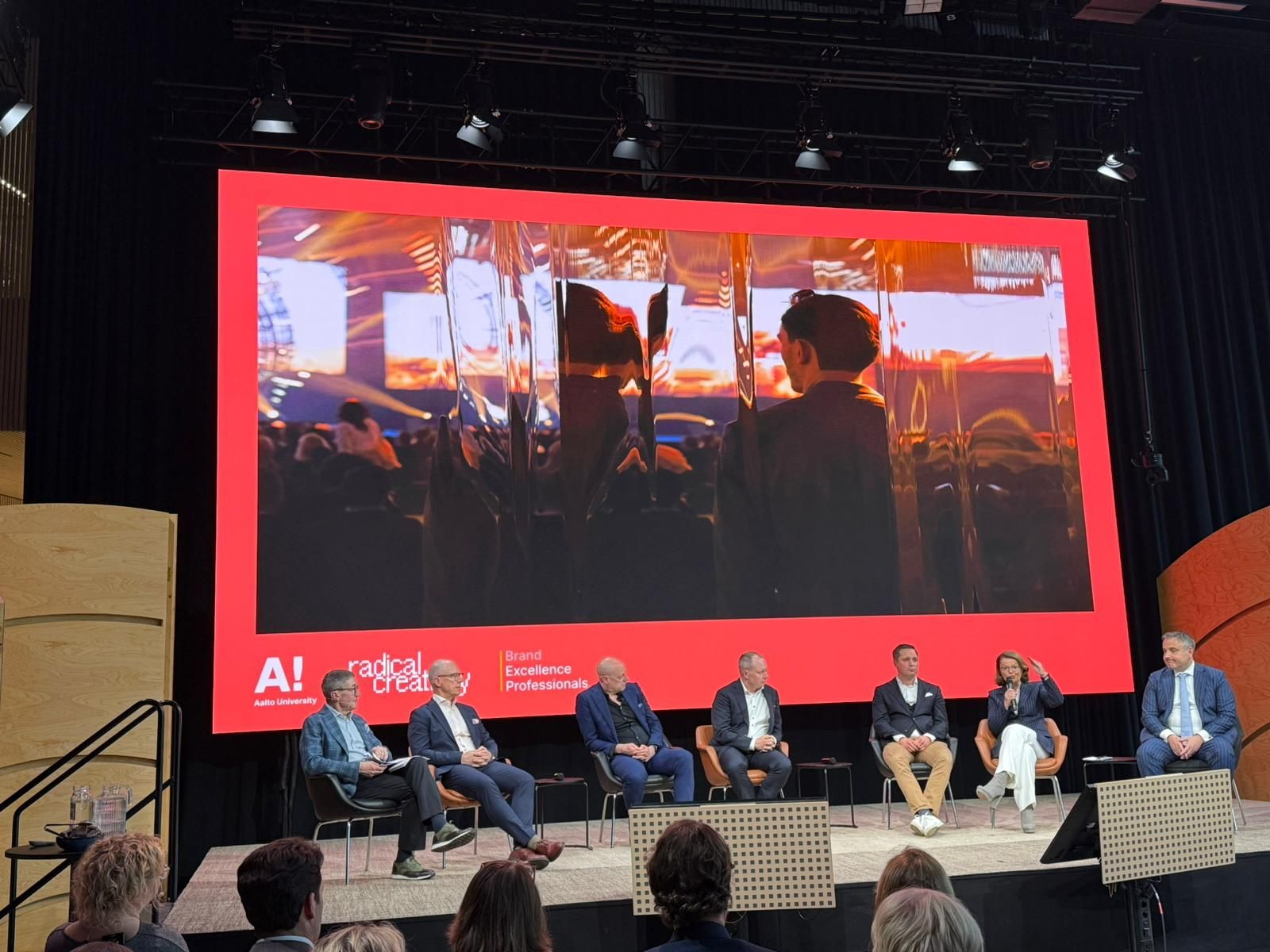
Panel discussion on "Radical innovation and leading change" was facilitated by Lauri Ratia, Board Chair and Senior Advisor, and featured CEOs of Oras Group, Posti Group, PwC FInland and IBM Finland Kari Lehtinen (Oras Group), Antti Jääskeläinen (Posti Group), Kauko Storbacka (PwC Finland) and Matias Karvinen (IBM Finland), alongside Board Advisor Marina Vahtola and Sampo Hämäläinen, Founder of Vuono Group.
IKEA Didn't Win on Products. It Won on Process.
Most of us know IKEA. Few of us have stopped to think about why it works.
IKEA's competitive advantage is not the Billy bookshelf or the meatballs. It is a ruthlessly engineered end-to-end process with standardised product components, flat-pack logistics, global warehousing, and, crucially, a customer who willingly performs part of the process themselves. Pick. Pack. Assemble. What looks like a quirky shopping experience is actually an elegant transfer of labour, enabling a supply chain that is extraordinarily capital-efficient.
That is process innovation at its most powerful. And yet, in boardrooms across Europe, process development is still too often framed as operational housekeeping like incremental improvements, cost reduction or IT upgrades. It rarely sits at the strategy table.
It should.
The New Challengers Don't Have Warehouses
Now consider Shein. The Chinese fast-fashion platform advertises individually personalised products that do not yet exist. When customers order, a micro-batch is produced on demand through a supplier network orchestrated by AI. No inventory. No warehouse capital tied up. A batch of one, scaled through algorithms.
Whether you find Shein's business model admirable or troubling is beside the point. What it demonstrates is something profound. In the AI era, "economies of scale" no longer require scale in a traditional sense. You no longer need a warehouse the size of a small town. You need data, models, and a process architecture.
“In the AI era, “economies of scale” no longer require scale in a traditional sense. You no longer need a warehouse the size of a small town. You need data, models, and a process architecture.”
This should give IKEA, and every industrial company, pause. IKEA's brilliance is inseparable from standardisation and inventory. That is also its constraint. What would a Chinese AI-native furniture company's order-to-delivery process look like? What about a global manufacturer of complex industrial equipment, with its service contracts, spare parts networks, and customer processes? What about your company?
Leaders Are Measuring the Wrong Things
When organisations talk about AI transformation, the conversation gravitates toward metrics like: How many use cases have we identified? How many pilots are running? How many agents have we deployed?
These are vanity metrics.
Business value – and business waste – is created step by step, process by process. A fleet of AI agents that isn't anchored to a redesigned process produces, at best, local efficiency gains. At worst, it produces chaos at speed.
Sam Altman noted earlier this year that AI has not yet truly penetrated enterprise business processes. He's right. And both OpenAI and Anthropic have since announced massive investments aimed precisely at that gap. The window to lead — rather than follow — is open, but it won't stay open forever.
What Leaders Actually Need to Do
The role of leadership in AI transformation is not to sponsor a pilot programme or nominate a Chief AI Officer and consider the job done.
CEOs don't need to map handoffs or audit workflows. But they do need to internalise one idea: Business value is created in processes, yet we organise in functions and invest in systems. That gap between where value actually flows and where attention and budget go is where transformation stalls.
From that mindset, three things follow:
Set the ambition. Ask the blank-slate question: if we were building this from scratch today, unconstrained by legacy, what would it look like? That vision belongs at the top.
Demand outcomes, not activity. The number of AI pilots, agents, or use cases on a roadmap is not a measure of progress. Ask instead: which processes have materially changed, and what is the business result?
Create the mandate for cross-functional process work. Because value flows across functions, the leaders who can break down silos and direct investment toward end-to-end improvement are the ones who will see compounding returns.
When strategic ambition and process redesign are connected, improvement becomes systematic. The gains compound. That is the flywheel that separates transformational outcomes from expensive experiments.
The Mindset Shift
Here is what makes this moment different from every previous wave of digital transformation. There are now entire categories of work — repetitive, judgement-light, high-volume — that were simply not worth redesigning before. The cost of change outweighed the benefit.
AI changes that calculus entirely.
Tasks that once required armies of people, or were quietly abandoned as too costly to address, are now tractable. The constraint is no longer technology. It is imagination — and the willingness of leaders to look at their processes not as fixed infrastructure, but as the primary site of competitive advantage.
The CEO panel at Aalto reminded me that this understanding is growing. But it needs to grow faster.

About the Author
Sampo Hämäläinen is a Founder of Vuono Group and a recognised advisor in connecting business processes, data and AI. He brings deep experience in technology services and digital advisory across manufacturing, energy, transportation and financial sectors. Sampo has a proven track record of building and scaling technology-driven businesses internationally.