
In 2022, Unity Technologies reported a major revenue hit after corrupted data affected its advertising systems. Extreme cases like this get attention, but the underlying problem is much more common in everyday business, as seen in Unity’s 2022 financial results.
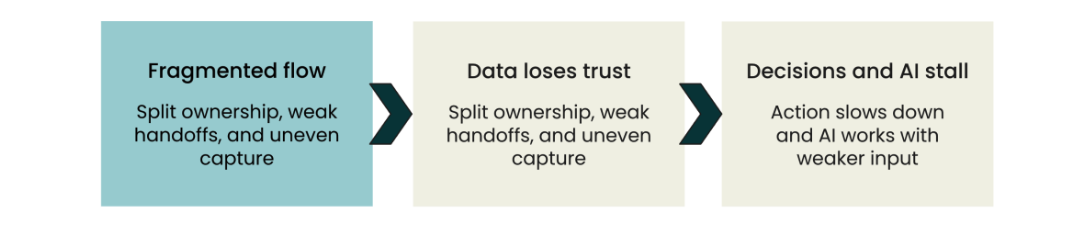
Most companies will never face a headline-making data failure. Their version is quieter: orders wait for clarification, forecasts need manual correction, and teams spend time reconciling numbers instead of acting. Bad data is usually the symptom. The real issue is broken processes, and AI tends to amplify those weaknesses rather than fix them.
“Bad data is usually the symptom. The real issue is broken processes, and AI tends to amplify those weaknesses rather than fix them.”
In client work, we often see the same pattern: the data problem becomes visible in reporting, but the root cause sits earlier in the process. The issue often begins in the handoff, with unclear ownership, or where the data is first captured.
This matters even more now as companies try to scale AI on top of fragmented processes and disconnected systems. Weak data flow slows reporting, but the impact does not stop there. It also reduces the quality of AI outputs and makes it harder to turn AI investment into measurable business value. Reports such as the Salesforce Connectivity Report (2025) and Precisely’s data integrity insights highlight this challenge clearly.
That is why this is not only a data issue. It is also a process issue, with direct implications for AI. AI can accelerate a good flow and help teams spot exceptions while supporting better decisions. What it cannot do is fix the structural weaknesses underneath, whether that means fragmented ownership, broken handoffs, or unclear decision logic.
Five patterns that block data and AI value
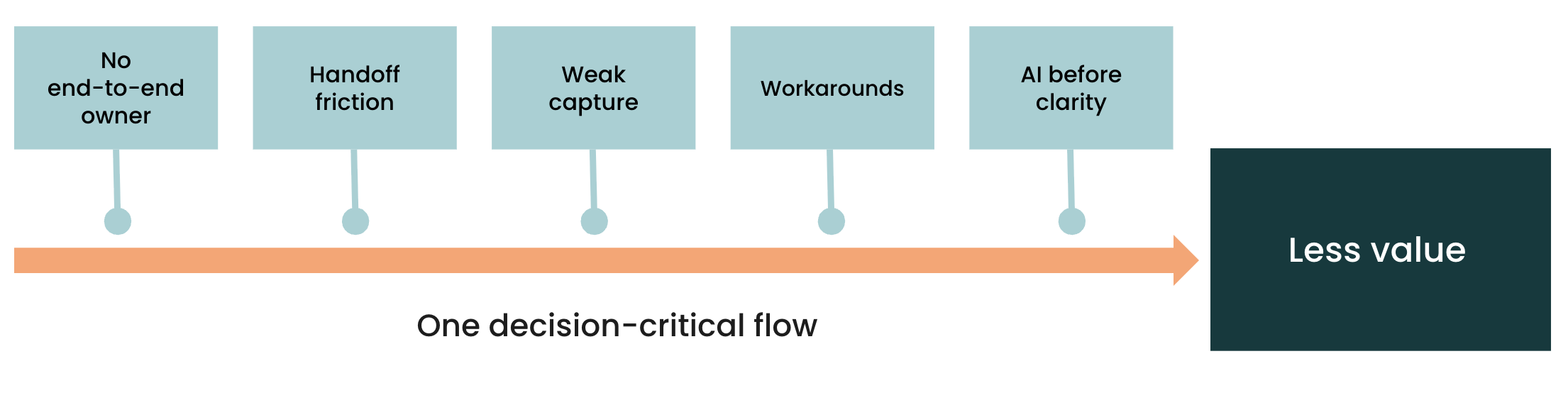
These process patterns show up consistently across industries, regardless of systems or scale.
1. End-to-end blindness
In many organisations, data is created in one team, updated in another, and used in a third. Each team knows its own task, but no one owns the quality of information across the full flow.
Bad data often starts in the gaps between steps, not in the dashboard. The same gap also weakens AI.
A simple test is whether the business can answer an end-to-end question such as: Which completed deliveries are still missing an invoice?
What to do instead:
Map one decision-critical flow end to end, not just the systems. Then name one business owner for the process outcome and the data quality it depends on — not only for individual tools or teams.
2. Handoff friction
Even when the right data exists, it often does not move cleanly enough to support quick decisions. One system has the customer status, another the order history, and a spreadsheet fills the gap in between.
Poor data often feels like a speed problem before it feels like an accuracy problem. The real question is whether the business can trust the information quickly enough to act.
What to do instead:
Start with one critical flow and fix the handoffs that delay real decisions. Do not begin with every interface in the landscape.
3. Errors at the gate
Many data issues begin where data is first captured. Missing validation, inconsistent formats, duplicate records, and incomplete entries may look minor in the moment, but they rarely stay local. If the point of capture is weak, every downstream tool scales the weakness.
A common example is supplier lead-time data: when no one can see when it was last updated, sales and planning teams either guess or stop to check before they can commit.
What to do instead:
Tighten data capture at the source. Make required fields, validation rules, shared definitions, and data freshness visible where the work happens.
4. Workaround creep
When the official process does not support the work, people create local fixes: spreadsheets, manual exports, side files, email approvals, and parallel trackers. In the short term, these workarounds help teams keep moving.
The problem comes next. Every workaround adds another place where information drifts away from the main flow.
What to do instead:
Do not start by banning spreadsheets. Start by fixing the process gap that made them necessary.
5. AI is a helper, not a shortcut
Many companies want AI to help them work around weak data and messy processes. The problem starts when they invest in copilots, agents, or automation before deciding which data, rules, and handoffs those tools should rely on.
AI can support decisions and automate parts of a workflow, but scaling that value often requires tighter integration between processes and systems, as highlighted by McKinsey’s research on AI and enterprise systems.
AI cannot create clarity where the process itself is still ambiguous.
What to do instead:
Use AI where the workflow, data logic, and decision point are already clear enough to measure. Treat AI as a helper in process transformation, something that accelerates a good flow, not a substitute for building one.
Fix one flow first
Saying “our data is a mess” may be true, but it is not yet useful. The better question is where poor data creates visible cost, delay, or risk in one real process – and what that implies for modern data leadership.
That is why a broad data clean-up programme rarely creates momentum. A narrower approach works better: choose one decision-critical flow, follow it from source to outcome, and improve the pieces that make that flow reliable. That is also the most practical way to introduce AI and to unlock its true potential through better business processes.
and to unlock its real value through better business processes.
A practical starting sequence is simple:
Pick one process where poor data already creates visible delay, rework, or risk.
Trace where the data is created, changed, checked, and used.
Define who owns the full flow.
Tighten standards at the point of capture.
Measure the effect in business terms.
Only then decide where AI or automation best supports the flow.
For example, AI may help by flagging stale data or prompting an update before the next decision is made. That process might be order-to-cash, customer lifecycle management, supply planning, or service operations. The goal is to make one high-value workflow work better end to end, prove the value, and build from there.
This is where a vertical-slicing approach becomes practical: improve one business outcome across the full flow instead of optimising isolated parts. Instead of treating data quality as a broad clean-up effort, focus on one decision-critical flow and improve it end to end.
In this context, vertical slicing means working through one real business flow across teams, systems, handoffs, and data issues until the outcome improves. It is a way to connect process improvement, data quality, and AI value in one measurable slice of work.
Closing
Poor data is rarely the root cause. More often, it signals that the surrounding process is too fragmented to support reliable decisions at speed.
So do not start with a broad complaint about bad data, or with the hope that AI will clean it up later. Start with one flow, one decision, and one measurable bottleneck. Improve the flow, and the data usually follows. Then AI has something real to build on.
“Improve the flow, and the data usually follows. Then AI has something real to build on.”

About the Author
Eero Siivola is a Data Scientist holding a Ph.D in machine learning and over 10 years of experience applying advanced analytics across diverse domains. He specialises in designing data workflows, developing analytical models, and leading projects from concept to delivery. Eero has a proven ability to translate customer needs into practical solutions that drive measurable business impact.